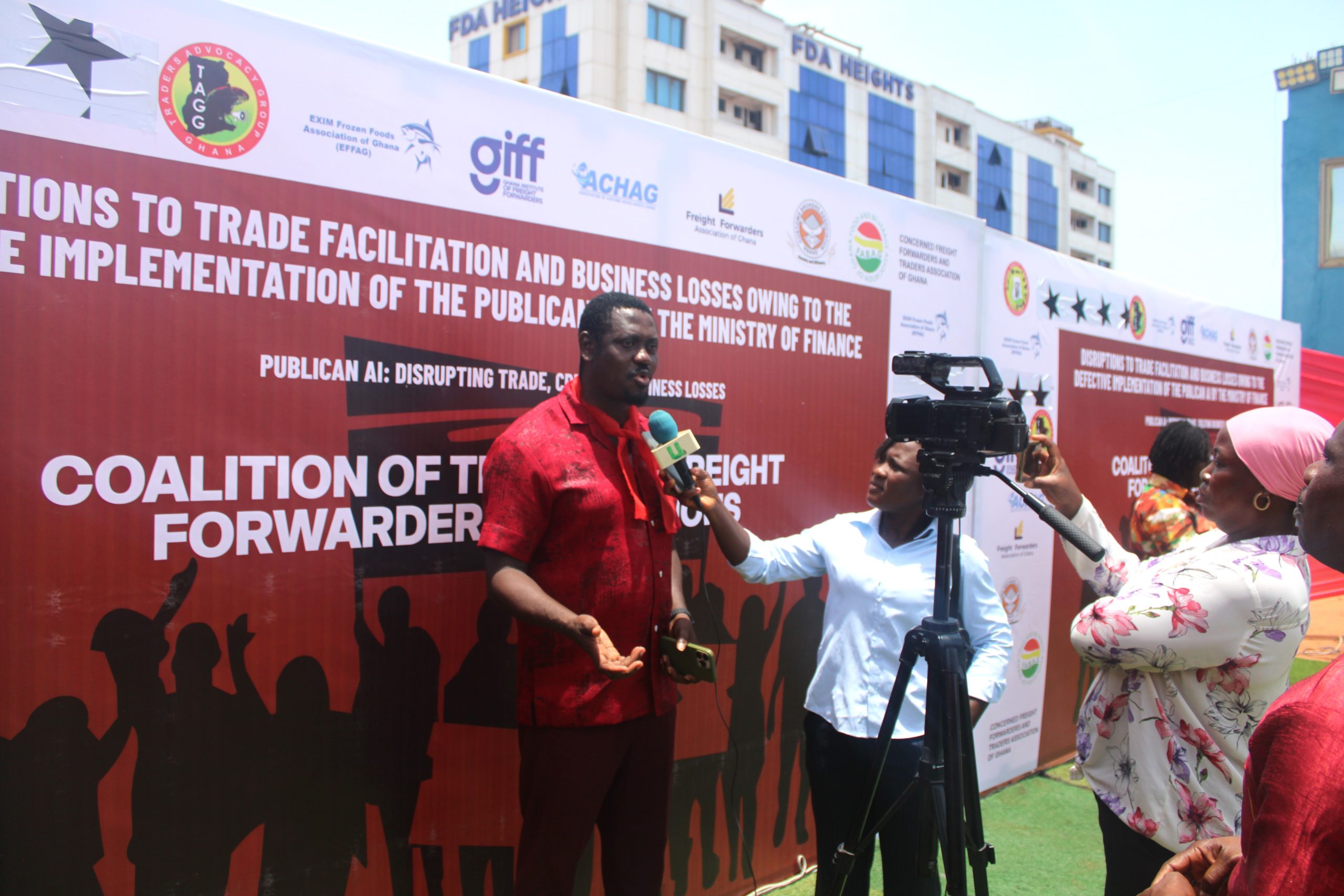

The Coalition of Trade And Freight Forwarder Associations comprising of GIFF, ACHAG, FFAG, FABAG, CUBAG,TAGG, EFFAG and other stakeholders clad in red bands, protest against challenges faced with the roll out of the Publican AI. Though the group has support for digital transformation and revenue mobilisation at Ghana’s ports, but they insists that the implementation of the Publican AI valuation system must align with international customs valuation principles, Ghana’s legal framework, and practical trade realities.
Over the past several weeks, the introduction of the Publican AI platform by the Ministry of Finance and the Ghana Revenue Authority (GRA) has generated growing concern among freight forwarders, importers, traders, and logistics stakeholders across the country. Industry players have cited excessive duty assessments, operational bottlenecks, centralisation of appeals processes, and inconsistencies in customs valuation following the rollout of the AI-driven system.
Speaking on behalf of a Coalition of freight forwarding and trade associations during a press conference in Tema, GIFF General Secretary Paul Kobina Mensah stressed that they support lawful enforcement, revenue mobilisation and the use of technology in trade governance, but such systems must be transparent, legally compliant and responsive to the realities of trade operations.
He further cautioned against implementing policies that undermine confidence within the trading environment.
“What we do not support is policy action that is rushed, unclear in scope, weak in consultation and disruptive to legitimate trade,”
Key major concerns highlighted by the Coalition group centres on the manner in which AI-generated values are being applied in customs valuation.
Mr. Mensah stated that aspects of the current implementation risk undermining Sections 67 and 68 of the Customs Act, 2015 (Act 891), which establish transaction value as the primary basis for customs valuation and outline internationally accepted sequential valuation methods under World Trade Organisation standards. Again, Mr. Mensah also questioned reports suggesting that Customs officers may reject AI-generated values whenever those values fall below benchmark expectations.
“If AI is introduced to remove human discretion, then why are we still allowing officers to choose between values?”
The group maintains that while AI can serve as an important decision-support tool, it must not become a mechanism for arbitrary assessments that create uncertainty and increase the cost of doing business.
Mr. Eric Amoah Amponsah who is GIFF Research Committee Head explained, “What the World Trade Organisation seek to do is that every invoice computation has to be based on the invoice value”.
The Coalition also raised concerns about the operational structure supporting the Publican AI rollout, particularly the centralisation of the appeals process. According to Mr. Amponsah, freight forwarders operating from border points and ports outside Accra are now being compelled to travel long distances simply to resolve valuation disputes.
“Before Publican AI was brought into the frame, every appeal was handled at the point of entry, If I am in Paga and I have a problem that needs to be resolved, you don’t have to come to Accra. Now, instead of us running a decentralised system, everybody has to rush to Accra. How does this AI help in this situation?”
There’s strong believe the current structure places unnecessary pressure on traders and freight forwarders, while slowing cargo clearance and affecting business continuity. Again, the Coalition warned that prolonged delays and unsustainably high duty values could weaken Ghana’s competitiveness as a preferred trade and transit hub within the West African sub-region.
Despite these concerns and others, the Coalition has emphasised that it remains committed to constructive engagement with government, regulators, and all relevant stakeholders.
The Coalition is therefore calling for:
• broader stakeholder consultation on the implementation of Publican AI;
• decentralisation of the valuation and appeals process;
• establishment of an independent and accessible appeals mechanism;
• greater transparency regarding the operational and technical framework of the system; and
• strict alignment with the Customs Act and international customs valuation standards.
The objective should not simply be revenue collection, The larger goal must be the creation of a smart, transparent, efficient and globally competitive trade ecosystem that supports businesses, protects government revenue, and strengthens investor confidence in Ghana’s ports and logistics sector, the group noted.